


Keep the court running. Even offline.
Our founder led Neoja's venue platform build in an employed role: registration, court controls and venue management connected to live basketball hardware.
At a glance
01 · Problem
The court had hardware. The venue needed software.
Guests needed to register, teams needed to run games, and staff needed live control over players, courts and hardware.
Why it hurts
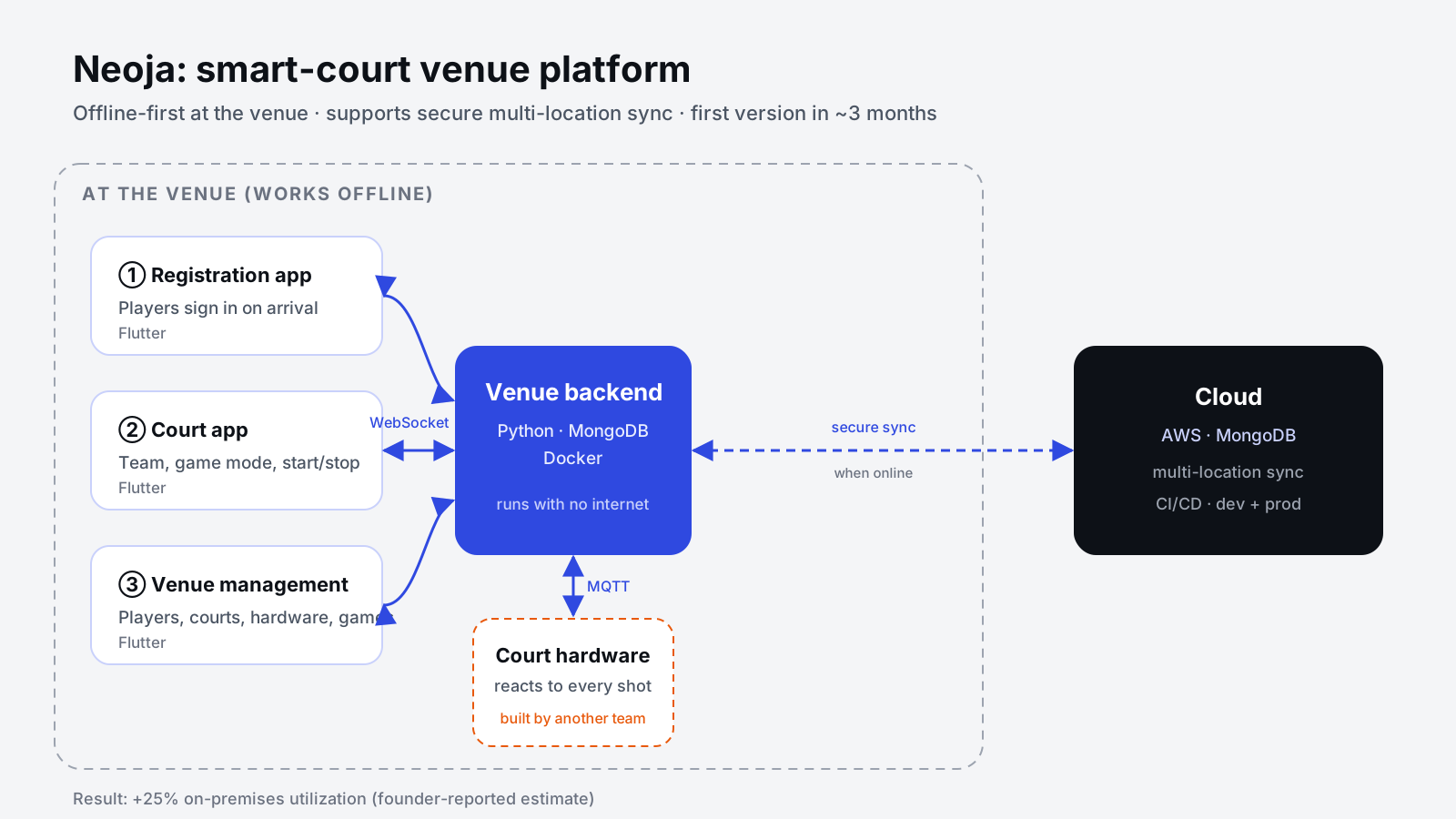
An event cannot wait for an internet connection. The platform also had to work with MQTT hardware built by another team, and support secure sync across locations.
02 · User
- Register on arrival
- Choose, start and stop a game
- Manage the venue during connection drops
03 · Flows
- RegisterPlayers arrive and sign in
- IdentifyA team selects the court
- ChoosePick a game mode
- PlayMQTT links the court hardware
- ManageStaff control courts and games
- SyncVenue and cloud reconnect
04 · Wireframes
0 screensOriginal app wireframes are unavailable. The flow above reconstructs the documented journey; it is not an original design artifact.
The offline constraint
A Docker backend ran at the venue. Local operation kept the event running, with secure cloud sync when connectivity returned.
05 · Design system
Original tokens unavailableNo original app design system or app screenshots are available. The diagram uses portfolio styling, not Neoja UI tokens.
Docker · AWS · WebSocket · MQTTCI/CD with separate dev and prod06 · Final
07 · Results
- First version
- ~3 months
- On-premises utilization
- +25% · founder estimate
- Venue connectivity
- Offline-first
How we measured
Our founder led this build as an employed full-stack engineer and tech lead at Neoja (2023–2025), not as a studio contract. The utilization increase is a founder-reported estimate, not independently measured. Secure multi-location sync describes a capability, not confirmed operation at multiple venues.
08 · GitHub
Client source is private. We can discuss the system approach without sharing client code.
Private repository